It's been awhile since I've posted here, but I've been unusually busy. Between applying for jobs last week, a hectic weekend with friends, and running a lot of errands this week, I haven't been writing much. So here's to getting back in the swing of things!---------------I grew up reading Robert W. Butler's film reviews in The Kansas City Star. In high school, I thought his opinion was law, and after an introductory film class at KU where I learned about editing and mise-en-scene, I spent a couple of years breathlessly following his recommendations for Criterion classics like The 400 Blows (there's two hours I'll never get back). These days, I'm more aware of Butler's biases. Any comedy--even a well-paced, joke-laden, emotionally relevant comedy--gets 2 1/2 stars out of 4 at best; any international or independent film--including long-winded, heavy-handed, emotionally flat films--are awarded 3 1/2 stars out of 4 at worst. Butler is prejudiced by his preferences (as any reviewer must be), but he always writes intelligently and convincingly and, well, a lot (he has three bylines in today's FYI Weekend Preview alone).My favorite piece from this week is his fall film preview "Duck and Cover--Doom and Gloom Await." Butler highlights the apocalyptic films lined up for fall and winter release, including a film version of Cormac McCarthy's The Road, the computer animated 9, and a cheesy-sounding Denzel Washington vehicle called The Book of Eli. The most compelling chunk of Butler's piece shows up right at the end: "It’s been noted that one reason science fiction is perennially popular is that it argues that mankind actually has a future. If so, why our fascination with end-of-the-world scenarios? Perhaps we subconsciously hope that if we get our cosmic comeuppance in the movies, we’ll somehow avoid it in real life."
As I would tell my composition students, Butler's tagging this tidbit on the end of his article to strengthen his conclusion, to go beyond the obvious educational premise of his article (to inform us about new sci fi releases) and make us think for a moment about human nature. This tail makes for a nice closing paragraph, but I disagree with Butler's interpretation of apocalyptic films. He doesn't put enough thought into answering his own question, and I'm sure he wasn't given the page space to do so.
People don't watch something bad happen on screen in the hope that it won't happen in real life. Films are vicarious by nature. People want what happens in movies to happen in real life, but they want it to happen without consequence; they want to see how it feels to foil a terrorist plot or fall in love with a best friend or enact some brutal revenge on a rapist without throwing away their own security to do so. How else can one account for the popularity of formulaic romantic comedies where the heroine (who serves a stand-in for the typical female audience member) gets the perfect guy? Why do we watch movies about mobsters and criminals if not to imagine what it would be like to feel so free, so powerful, and so violent without consequence?
We watch apocalypse and disaster movies because they illustrate and involve us in a horrifying reality for two hours while we enjoy the cushy safety of our theater seats. We watch them to bring our potential doom closer, not to push it away.
But why do we want to experience harrowing disaster again and again at movie theaters? As a big fan of sci fi, horror, and disaster movies, I have some hypotheses about the source of our love of apocalyptic cinema:
1) Spectacle: Apocalypse movies tend to include a lot of explosions, twisted landscapes, tidal waves, and alien spacecraft, which makes CGI professionals very happy and gives viewers a chance to see something familiar get completely demolished. (Did anyone watch Independence Day for any reason besides seeing the White House lasered into oblivion? I didn't think so.) These movies are usually action flicks at heart: they have a big visual wow-factor and lots of good, clean, family violence. It's the Colosseum all over again.
2) Adrenaline: Not only do these movies allow for plenty of chase scenes and war zone violence (see 28 Days Later and Mad Max), but they imbue the heroes and heroines with special importance: we want them to survive the apocalypse for themselves and for the rest of us. If a few good characters survive, then humanity survives. These movies ensure our unequivocal emotional investment in the films' outcomes and guarantee that we'll all be surging with adrenaline when the movies are over. We leave the theater feeling ragged, exhilarated, and a little high when our characters survive, and an excited film goer is a happy film goer.
3) Thought Experiments: Most apocalypse movies are science fiction, and sci fi thrives on brainstorming and enacting the future's possibilities. The best sci fi involves premises that are novel and inventive yet utterly believable, like Children of Men (humans mysteriously lose the ability to reproduce) and District 9 (aliens arrive on earth and get shunted into concentration camps because of their otherness).
Because apocalypse movies take our world and put it in crisis mode, they can be deeply mentally stimulating and topical (see District 9 for its take on race and refugee-ism, or read World War Z: An Oral History of the Zombie War for criticism of Americans' soft and impractical skill sets). Of course, the best sort of apocalypse movies are the ones where humans are responsible for our own destruction. These movies let the screenwriters and audience mentally gripe about humanity's failings and how nuclear weapons (The Day After), environmental abuses (The Happening), or moral and religious failings (Legion) will certainly be the end of us all.
4) Survivalist Fantasies: As I mentioned above, people love to imagine themselves as a movie's hero or heroine, and we love to do it even more with apocalyptic movies. Every time I see one of these films with a friend, we come out of the theater wondering whether we would survive a nuclear winter or a zombie apocalypse. Would I be tough enough to kill my newly zombie-fied husband? Would I be smart enough to hole up in a safe cellar with lots of guns? Would I be brave and industrious enough to venture out for supplies before I starved?
These movies serve as a mental testing ground for us, a sort of training that we (hopefully) will never need. Perhaps imagining the worst and mentally planning for it is innately human; maybe these mental exercises are instinctual games we play to prepare ourselves for the worst. We used to spend every hour of our waking lives planning for a tiger attack or a long, vicious, food-less winter; now, we spend our Saturday nights planning how we would escape paralytic tree pollen and volcanic fumes.
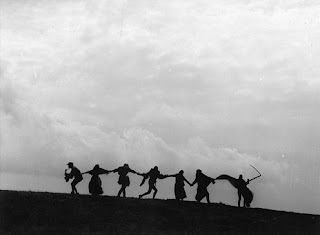
5) Catharsis: My favorite apocalyptic film is not a sci fi movie or a disaster flick. Ingmar Bergman's The Seventh Seal is really a historical drama about the black plague. It's relentlessly dark; everyone dies, and though the characters hope to make it through the next wave of disease, their hope is flimsy at best. Death wears a long black robe and stalks the main character. The movie's only jokes involve paintings of chess-playing skeletons. Everyone does a little death dance at the end.
The movie captures the apocalyptic mood of the Middle Ages when everyone really believed that God was wrecking his revenge upon the world's sinners in the form of black pustules and overwhelming agony. Its characters truly believe that the world is ending, that life is nothing but death and loss, and there's a finality to their attitude that goes far beyond pessimism or even fatalism.
Whenever I watch The Seventh Seal, I find myself wallowing in its dark mood, in its sense of utter defeat. I enjoy the feeling that nothing matters because everything and everyone is an instant away from death. The feeling is sickening and somehow freeing at the same time, and when I turn off my DVD player, I am inexplicably cheerful about having looked at the rotting underbelly of life and seen its worst. I don't feel grateful that my life is not so bad as the lives of the plague victims, and I don't value my health or my family any more than I did before. And yet, illogically, I feel better, somehow. Why?
Aristotle described catharsis as "the human soul [being] purged of its excessive passions" by watching another person's tragedy unfold on stage. The experience is pleasurable because it is healthful; once the audience's despair, fear, and hatred has been spent in empathy with the ill-fated actors, their emotional balance is restored and they are happy again.
Perhaps catharsis is why we love to watch our world end again and again: once we've seen it happen to someone else, felt the horror of death and the sorrow of loss through our hero or heroine, perhaps we don't need to worry about our potential for self-destruction any more. We already know what it will look like when it happens.