Showing posts with label reading. Show all posts

1.29.2012

If Zadie Smith and Douglas Adams Had a Baby . . .

it would be precocious and aggressively clever and named January 2012.

Work has been so hectic this month that once January 23rd rolled around, I realized that I had only read one book since the new year: Zadie Smith's Changing My Mind: Occasional Essays. "Only one?!" I thought. "I'm shooting for 52 total this year! I can do better."

Besides the busyness, I can also blame my lack of book-reading on my scattered forays into essays and poetry and stories that were way too heavy for winter months, like Kafka's "Metamorphosis" and a few choice back issues of The New Yorker and bits of The Best American Poetry of 2011 and Great English Essays: From Bacon to Chesterton. It was all very intellectually stimulating and vocabulary expanding and also sludgy and dreary, and it contributed nothing to my Goodreads list.

Smith's essays went along this same erudite vein, and they were painful in the same way that stretching a muscle you don't use very much is painful: it's difficult, and it burns, and your butt may feel like it's all the way across the room, but it's also invigorating and relaxing and almost certainly (you tell yourself) "for your own good."


Changing My Mind collects Smith's previously published essays on a mixed bag of topics, from reading her favorite authors (Zora Neale Hurston, George Eliot, Nabokov, and David Foster Wallace) to touring through impoverished Liberia and fancy dress parties in LA, to reviews of bad movies and British humor, to her father's death.


Smith opens her collection with an essay about her love for Their Eyes Were Watching God. She describes her relationship with this novel as "extraliterary": she appreciates Hurston's style and skill as an author, but she truly loves the novel because she feels like she shares Hurston's values, her story, her struggles and loves. I felt the same way about much of Smith's writing: I thought she was at her most brilliant when writing about authors I already loved (Hurston and George Eliot, specifically), but she lost me where our opinions differed; I very dutifully read her essay on Barthes and Nabokov and her (very, very) long paean to David Foster Wallace, but those bits of writing didn't sing for me.

Still, I was happy to have found something from Smith that I enjoyed; I read the first 200 pages of White Teeth, her wildly popular debut novel from 2000, and loathed it, so I was happily surprised to enjoy so many of her essays so much. I've gained respect for her obvious intelligence; her muscular, efficient, nuanced prose; and her ability to make me look up words on my Merriam-Webster dictionary app ("patois," "lacunae," "apogee"--never stop, Zadie! you're making me a smarter person!).

But after Smith's weight, I had to cleanse my reading palate. I turned right to Douglas Adams's  The Hitchhiker's Guide to the Galaxy at the recommendation of a friend, and I wished instantly that I had read it when I was 12: it's manic, sugar-coated, and wildly imaginative. It's also more over-stuffed with jokes than (as my father would say) 10 pounds of potatoes in a 5-pound sack. And while part of me thought, "Douglas Adams, this much funny is like serving me a bowl of gravy at Thanksgiving dinner. Yes, gravy is delicious, but where's the meat, buddy?" it was also quick and silly and just what I needed on January 26th, 2011.


What's next on my winter reading list? Definitely another tawdry faerie novel from Laurell K. Hamilton (after tackling Kafka for the first time, I've earned it!), as well as the steampunk YA novel Leviathan and maybe Game of Thrones or Ready Player One. Let my sci-fi/fantasy winter begin!

12.31.2011

My Year in Lists: 2011


Reading
  • Final count: 47 books, including fiction, nonfiction, and poetry!
  • Most fun: The Beekeeper’s Apprentice, which I read twice! I also read the first five sequels in the Mary Russell series in a matter of months.
  • Biggest surprise: Eat, Pray, Love. I can admit that I found it profoundly moving when I read it last spring. Sometimes books live up to their hype.
  • Greatest accomplishment: Vanity Fair. It was looooooooong. Fortunately, its awesomeness was proportional to its length.
  • Highest quality to quantity ratio: Winesburg, Ohio. Written about small town Ohio in the early 20th century, Sherwood Anderson's tiny little collection of short stories was phenomenally beautiful, sad, and honest. I have no idea why I left it collecting dust on my To Read bookshelf for so long.
  • Best poetry: Sleeping Preacher
  • Fictional character I was most in love with: It’s a tie between Mary Russell’s Holmes or Mr. Thornton from North and South. (Feel free to draw your own conclusions from this!)

Television
I was all about period dramas this year. My favorites were
All three of these were superbly written and beautifully produced and addictive as all get out. Thank you, Netflix!

Music
What didn’t I listen to this year? Here’s a playlist of a few of my favorite songs from a few of my favorite artists this year. Most of these albums didn't come out in 2011, but they've all spent a lot of time on my iPod in 2011. 


Real Life
This year was tumultuous, at best, and while I was never bored, I was never quite at ease, either. 

The good:
  • Three good friends got married and another got pregnant for the first time. 
  • I got a new job that I love and am consistently challenged by.
  • I traveled to Denver and Winfield and Manhattan, Kansas had a great time with friends at all three locations. 
  • I did a lot of yoga and played a lot of softball and even did a bit of belly dancing. 
  • I started a book club with my friends.
  • I submitting my writing for publication again for the first time in years, and had a poem accepted for publication sometime in 2012!

The bad:
  • I had an icky bout of bursitis that kept me on the couch for a good chunk of the fall. 
  • My university went through a substantial restructuring process, and not everyone made it out unscathed. 
  • My mom was in the hospital twice and recovering from surgery for a good part of the year.
  • My grandma was in the hospital for a stroke and had to move to a nursing home with her husband in the fall.
  • My grandpa was in the hospital twice, first for a hip injury and again for blood clots a few weeks ago.

The confusing: 
  • Even awesome new jobs can be terribly stressful, baffling, brain-addling things.
  • I set aside my first savings for retirement and taught myself about a bunch of grown-up stuff like building credit and buying cars and health insurance deductibles. Yay responsibility?
  • I spent a lot of time thinking about Occupy Wall Street and the recession and global warming and the crimes at Penn State. The future seems more complicated and challenging than it ever has before.

When I look back on this year, I think that I’ll remember it as the first time that I realized that whenever life gets harder, sadder, or scarier, it also gets more interesting, gains a richer texture, becomes more precious and vital in its complexity. Life is a bit like beer: yes, Bud Lite (i.e. college life) is easy to drink, but it’s the bitter complexity of the hops that makes an IPA (being a 28-year-old) memorable. 

I’m glad I was here for 2011, whatever challenges it’s held, and I’m glad I got the chance to drink it to its dregs. So if you're lucky enough to live in the Midwest, go find yourself a Boulevard Single-Wide IPA and have a happy new year. See you again in 2012!

11.13.2011

The Vampire Diaries: A Comparative Review

So for the past couple of months, I've spent a lot of time holed up in my apartment due to some epic hip pain. I have bursitis in my hips. That's right, bursitis. And, yes, this does mean that I'm an 80-year-old trapped in a 28-year-old's body: I also spend a lot of time cat cuddling and tea drinking and thrift shopping and grouching at the noisy youngsters who walk past my bedroom window and staying in to quietly listen to NPR. I'm cool with it.  ;)

Anyway, my bad flare up has had one good consequence: I've had the chance to spend a lot of time sitting on my couch,  icing my hips, and watching The Vampire Diaries. Created by The CW, The Vampire Diaries is one of those shows that shouldn't be good but is. It's a vampire show written for teenagers, but don't think Twilight--think True Blood with more high school and less nudity. 

The Vampire Diaries

The Vampire Diaries follows a 17-year-old girl named Elena who just happens to have two really fantastic looking vampire brothers fall in love with her. She spends a lot of time tenderly embracing one of them (Stefan) and kind of flirting with the other one (Damon) and fending off other mean old vampires who just happen to not be in love with her. And, of course, there are some witches and werewolves hanging about and a lot of relationship drama and witty repartee. Add in a whole lot of painfully good looking people and a dash of gratuitous violence and it makes for a heady, addictive mix. It's not quite as clever as Buffy the Vampire Slayer, but The Vampire Diaries has more plot twists than a spy novel and surprisingly complex characters who actually manage to grow from episode to episode (which is more than a lot of TV series can claim). 

But after the first few episodes, I kept thinking, "Hmmmm, the names Damon and Stefan sure sound familiar." That's when I realized that the show was based on The Vampire Diaries novels written by L. J. Smith which I had owned and read when I was all of 13! I remembered not being a big fan of the series (I'm pretty sure that I sold them at a garage sale when I was in high school), but I adored (and--I will admit it--still own) her other four series: The Secret Circle, Dark Visions, The Forbidden Game, and Night World. I read and re-read those books, like, a lot. And I'm secure enough in my intellectual and literary tastes to admit it.  ;)

The Secret Circle and Dark Visions. (Oh, yes, I did find these on one of my bookshelves!)

All of these books involve witches, vampires, werewolves, psychics, or some combination of these supernatural types, and they're all very romantic and soul mate-y and "tragic" and probably horribly obnoxious, but I loved them all. I doubt that they would hold up to being reread by my adult brain, but I can't regret those hours I spent as a lonesome, awkward, angry, dreamy junior high student, laying in my bed re-reading those novels, wishing that something, anything, exciting would happen to me. (Heck, I wouldn't have minded a bite-y vampire boyfriend, so long as I had one!) Those books were just right for me when I read them, no matter how horrifying I would find them now, with their lovely, thoughtless heroines and their menacing, controlling supernatural boyfriends. 

The newest The Vampire Diaries edition.

But, of course, I had to at least try to reread The Vampire Diaries novels to see how closely they followed the show, and this proved to be one of those rare occasions where the screen version of something vastly improves upon the original text. 

The writers and producers at The CW have (thankfully) taken a lot of liberties with the novels. The books are abjectly awful; I made it through the first one only by reading every fourth word and flipping a few pages ahead whenever I was annoyed or horrified or confused by a character, a plot point, or an adjective (this happened a lot). The main character was awful, the writing was insipid (yes, tell me more about how Elena's furniture was Victorian cherry wood and she wore a peach colored silk ribbon in her hair, because that is both realistic and vitally important to my understanding of her character!), and the plot was mainly about how making out with vampires is not just fun--it's fulfilling! I mean, these books make Twilight read like Hemingway, all precision and restraint and deep, deep feeling. 

When will I ever learn not to read books whose cover blurbs start with "A DEADLY LOVE TRIANGLE"?!

But I would still highly recommend the show, no matter how sordid its origins. It does a great job of yanking out the best parts of the original novel's story-line and trashing the rest: Elena's personality is (thank goodness) drastically different, she's given a little brother and a slew of friends with compelling story-lines of their own, and the tumultuous relationship between the two vampire brothers is probably the most complicated and meaningful relationship in the show. Instead of being about vampires or (*shudder*) soul-mates, The Vampire Diaries manages to be about the strength of family bonds, self-transformation and redemption, and accepting one's past. 

And let's be honest: who would ever turn down two really pretty vampire boyfriends for the price of one? 

(Don't forget to wipe the drool off your keyboard before you go, ladies!)

10.25.2011

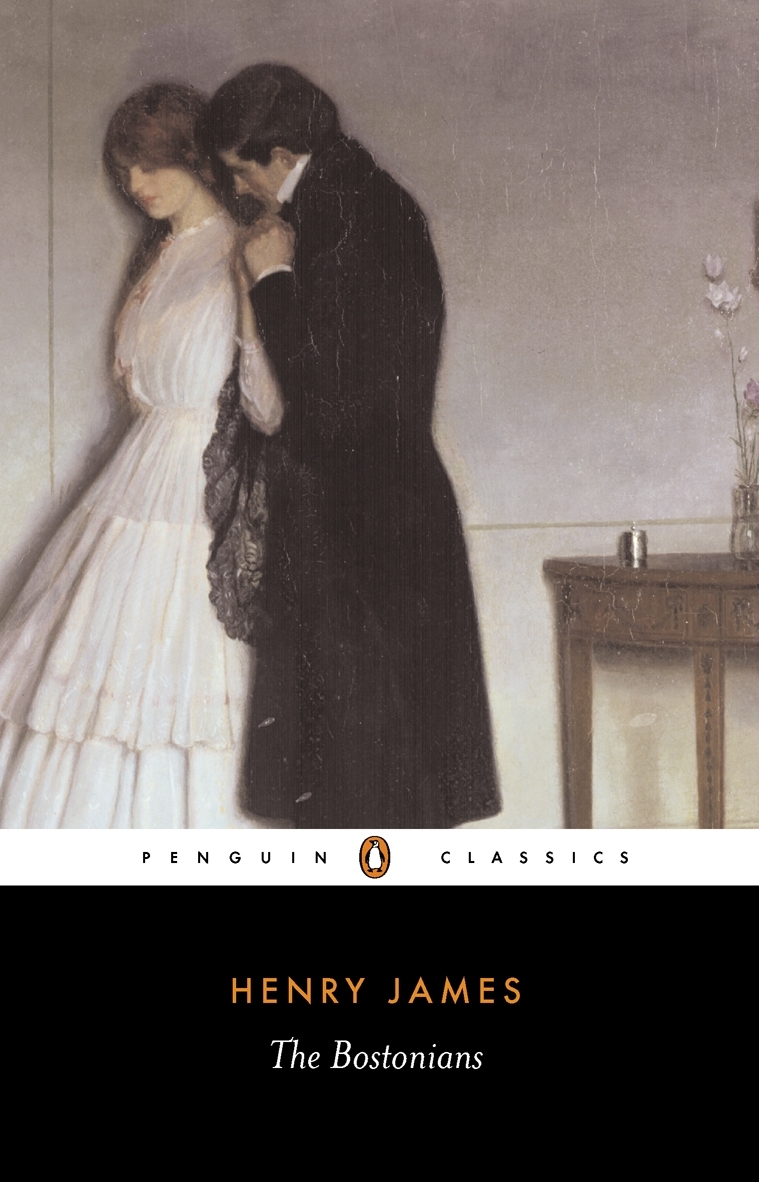
The Bostonians by Henry James

After a long and happy lifetime of never reading any Henry James ever except for "Daisy Miller" in a sophomore year English class, I finally tackled The Bostonians
The Bostonians
In the past, James had always struck me as unbearably stuffy: his sentences had more clauses than a mall at Christmastime (ha!), and his paragraphs went on for pages and pages, and everyone was always making themselves so unbearably happy because of their tight, tight Victorian corsets. Basically, he seemed like a chore. But I had started The Bostonians in grad school, and I hate leaving a book half done, especially when I was enjoying it in the first place.


The Bostonians, despite being one of James's lesser-known novels, does not disappoint. I suspect that it's rarely read these days because it's so topical: it deals primarily with women's suffrage, or, as it was known in 1885, "The Woman Question." The novel centers around Verena Tarrant, a beautiful, red-headed young woman who just happens to be an electrifying public speaker interested in equal rights for women. Her family is poor, and her father is a disreputable mesmeric healer, which means that Verena is not only talented and on the rise in society, she is also dismally unprotected and without means of her own.

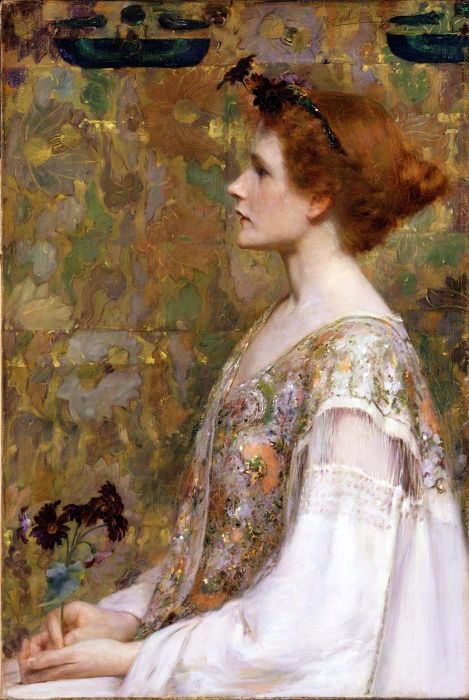
Woman with Red Hair, Albert Herter, 1894.
At her first speaking engagement in Boston, Verena meets Olive Chancellor and Basil Ransom (do I even need to mention those uber-obvious thematic names? oy!), two cousins who both begin, in their own ways, to woo Verena.

Olive wants Verena to stay unmarried, to live in Olive's home, and to travel the world, bringing a message of equality to the world. Basil Ransom, on the other hand, wants Verena to marry him and leave the public eye for good so she can spend the rest of her life entertaining and tending him (I'm not kidding--he actually says this). As the book builds toward its agonizing climax, Verena is forced to choose between a life on the world stage and a life that can be contained in a single sitting room.

What fascinated me about this book isn't its subject or even its plot, it's the fact that it's a novel without heroes. Verena is lovely and innocent and very sweet, but she also bends happily to the will of whomever's in the room at the time. She's a pushover by nature and by station. Olive Chancellor is zealous, brittle, tyrannical, and manipulative. Ironically, for all her passion for women's rights, she allows Verena no freedom of her own. Basil Ransom is handsome and charming but skin-crawlingly insidious: his love for Verena is a passion for possession and control. He wants to marry her, but primarily as a means of keeping her from "parroting" feminist beliefs that he doesn't believe she could possibly understand.

Verena is only given two extreme choices in the novel and no chance of winning, and that, I think, is the entire point. James refuses to espouse either ideology in this novel: he seems disgusted with the rhetoric of the women's rights movement (which he portrays as extremist and heartless), and yet he portrays their detractors (traditionalist Victorian males like Ransom) as pirates and captors.

Boston, 1880s.
Once she emerges into the upper classes of Victorian America, Verena cannot escape. In a world where she was truly free to build her own life, Verena Tarrant wouldn't have had to pledge herself to the rich yet spartan Olive Chancellor as her patron, ruler, and near lover, nor would she have to succumb to the seduction of the romantic but appallingly misogynistic Basil Ransom. If she were free, she wouldn't have to choose between being a feminist zealot or an obedient wife, a Northerner or a Southerner, a thinker or a feeler. She could be a little bit of all of these things and, most importantly, her own self.

But Verena is not free, which makes James's novel incredibly suspenseful and sad. If you're going to give James a try, I strongly recommend The Bostonians.

9.05.2011

Sleeping Preacher

Have you ever put off reading a book for one reason or another, only to finally read it and desperately regret your years of hesitation? That's what happened to me last week with Julia Kasdorf's Sleeping Preacher. Kasdorf was one of my instructors at Penn State. I've always loved her poems (I wrote about one here), but Sleeping Preacher was her first book, a book that I knew she had a love-hate relationship with. I just wasn't sure that it would be as moving as her later work, so I put it off.


But this book was far better than I ever expected. Kasdorf has described it as her "where I'm from" book, the collection that she wrote about her Mennonite family, growing up in small town Pennsylvania, and leaving that world for New York. It's a stunning collection: clear, purposeful, understated, and sparklingly lyrical. Kasdorf writes the type of poetry that gives you a sense of not just a time or place or experience, but of the woman behind the poems, the personality and passions that paint her experiences with meaning. It's no wonder that, out of 900 other first book manuscripts, Sleeping Preacher won the 1991 Agnes Lynch Starrett Poetry Prize.

Kasdorf starts the collection out with a whammy of a poem "Green Market, New York", which places her in conversation with a Pennsylvanian farmers' market vendor in the heart of New York City. It's not just a good poem--it also serves as the book's thesis, flinging the whole text into tension and motion:

"'Do you live in the city?' she asks. 'Do you like it?'
I say no. And that was no lie, Emma Peachey.
I don't like New York, but sometimes these streets
hold me as hard as we're held by rich earth.
I have not forgotten that Bible verse:
Whoever puts his hand to the plow and looks back
is not fit for the kingdom of God."

From there, the procession of quiet, kind poems moves from Kasdorf's parents' childhood into her own childhood and adulthood. And while the book is known for its Mennonite subjects, some of my favorite poems were the later ones, the adult poems that are connected to other places and personalities far from Kasdorf's childhood. I loved "For Weatherly, Still in New York":

"This place could make you well.
Night, a black healer, comes so dark it kills
as it cures. Stars slice your fingers
if you try to catch them, falling.
This is no dinner invitation [. . .]
you can't stay on the Lower East Side,
or at least stay there and stay sane.
Come, lose your lease for this place."

"The View" was another favorite. The poem is dedicated to a friend who has moved to the shores of Lake Michigan. I especially love the subtle, lilting rhymes nestled within the lines of this poem. It's a technique that, I will admit, I plan to do my darnedest to steal from Kasdorf!

"[. . .] Last week, a wind charged
off the lake so cold pigeons froze to the walks,
four iridescent necks just on your block.
But all the cold carcasses in Chicago
mean nothing next to your view. Although
I never held still for your caresses,
I admit your talk makes me jealous:
the way you speak of the lake like a love
and refuse to hang drapes, the way you scrub
the panes until they seem to vanish into
the view. And lake and sky embrace you."

Julia has a new book of poems out called Poetry in America. Go get yourself some--I know I'm going to.


6.30.2011

Summertime . . .

and the living is hot. Like really hot. Like "Oh, good Lord, where's the ice bath?!" hot.

The first 100 degree day of summer is upon us here in Kansas. Instead of getting cranky about it as I sweat to death on my couch, I want to write about my favorite summer things. The power of positive thinking and all that.  ;)

Here's what I love about summer:

  1. Produce, produce, produce. There's so much delicious fruit in grocery stores and at the farmers' market that I actually have to work to eat it all. It's fantastic: first come the strawberries, then the nectarines and peaches, then the melons, and, of course, there are always the apples to look forward to in the fall. And don't even get me started on the cucumbers and salad greens! Ooooo, the salad greens! (Okay, so I like food--can you tell?)
  2. The smell of barbecue. I like the taste, too, but barbecue is so heavy that I prefer salads and hummus and veggie-based dishes in the summer. Ugh, who can handle a belly full of greasy brats and burgers when it's this hot? But the smell permeates my neighborhood as the college kids crack open beers and grill on their decks. All of downtown is rich with charcoal smoke, Frisbee games, and lawn chairs.
  3. How cold things taste extra amazing. Ice cream. Popsicles. Frosted and dripping bottles of beer straight from a cooler. Enough said.
  4. The lake. I haven't gone swimming this year, but I'm desperate to! I miss wasting a whole afternoon splashing around in Clinton Lake between rounds of laying out under the blistering sun. (Well sun screened, of course!) And it's weird, I know, but I love the smell of the lake--it's so rich, so fishy and dirty and musty and gloppy somehow. It smells alive. I like it much, much better than chlorine.
  5. Music. There are silly summer hits on the radio and fantastic concerts in Kansas City every night of the week. I've only gone to one show so far this year, but I've passed up about four great ones due to time conflicts. The music industry (and the whole world, it seems) is so gloriously busy in summer!
  6. Nighttime. For me, my least favorite thing about summer is that the heat makes it hard to get a good night's sleep (at least in my apartment!). But the upside is that everyone seems to stay up a little bit later to take advantage of the cool night air. Summer nights are great for parties, for camping, for movie marathons, and for reading late into the night. There's something truly wonderful about being up at 3:00 a.m. on a summer night to hear the cicadas singing in the cool, damp air, and watching the moon high and bright overhead.
  7. The haze. I love how everything and everyone slows down when it's really hot. We have no choice in the matter: the air feels like molasses. It's hard to move, to breath, to even think. The promise of heat stroke makes everyone pant, sweat, and sprawl their way slowly through the daylight hours. It's a sort of forced laziness. You have time to hear the crickets creaking, to watch the lightning bugs flicker, to smell the damp grass when twilight comes. Summer may be the loudest season--full of bugs and animals, fireworks, outdoor festivals, and wind--but  it always feels like the quietest season to me. It asks me to feel the sweat and salt on my skin, to stop moving so far and so fast, to hear my own thoughts moving through my own head. 

6.19.2011

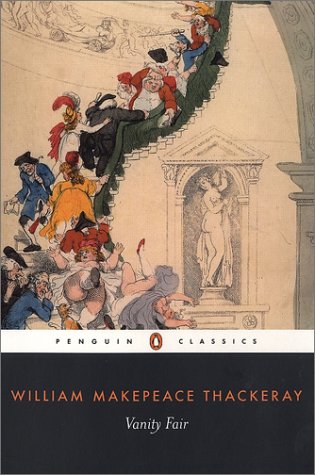
My Big Fat Summer Reading: Vanity Fair

Last summer, it was Middlemarch. This year, I'm having a go at William Makepeace Thackeray's Vanity Fair. My annual way-too-long novel read has begun!


I was inspired to read Vanity Fair for two reasons: 1) Vanity Fair, the movie.


Actually, I've never seen it, even though it came out seven years ago. I make it a point to never watch a movie about a book that I might someday want to read. I get the actors' faces in my brain and I can never get them out again, which shapes the way I visualize the characters forever and ever and ever. I was afraid that I'd watch the film and never get Reese Witherspoon out of my version of Becky Sharp again. So, basically, I couldn't watch the movie (which looked really, really tempting) on Netflix until I committed to the novel.

And 2) I came across this awesome The Hairpin article about great classic novels with mean female main characters. It was funny and clever and totally convinced me that Thackeray was worth tackling. (Carrie Hill Wilner also wrote an article that convinced me to read Charlotte Bronte's Villette, which I totally enjoyed. So she's pretty much batting a thousand at this point!)


Anyway, a long jaunt through 19th-century England felt like exactly what I was looking for this June, and, so far, it has been! The novel is rife with earnest yearning and satire, innocence and deceit, creditors and debtors, outrageous wealth and the illusion of outrageous wealth. I sort of love Becky Sharp for all her shallow, back-stabbing, social-climbing ways--she's so good at what she does that it's difficult not to admire her. She's selfish and sometimes cruel, yes, but she's also doggedly clawing her way up in the world in the only way available to her, and her savvy and determination are remarkable.

But I also love her tender-hearted, naive, helpless best frienemy Amelia Sedley. In fact, I think that Thackeray is a great novelist precisely because he makes it possible for me to love both characters. Though the novel is known as a biting work of satire, I think that, at its heart, it's also a book written with a lot of empathy, understanding, and even gentleness.

I'm about 580 pages into its 800+ pages, and I'm on a pretty good tear (now that I'm past that really dull stretch about the battle of Waterloo--sheesh!).


 In fact, the only thing I don't like about Vanity Fair's length is that I have a huge stack of library books on my kitchen table that I desperately want to get to. There's Lord of the Flies and Howard's End and Wives and Daughters and Jennifer Egan's A Visit from the Goon Squad (which is my new book club's first read!). I'm definitely looking forward to the last forth of Vanity Fair, but I have so many treats in store--it's looking to be a great summer so far!

5.21.2011

The Art of the Nap

This morning, I woke up and promptly decided to do nothing with my day.

I had plans to go to the farmers' market downtown and errands aplenty to run, but after a cup of coffee and two toasted pitas with peanut butter, I hit the couch and haven't moved since--except, of course, to transition back to bed where I could better enjoy the warm breeze coming through my bedroom window, the buttery Saturday morning sunlight, and my comforter (which is just thin enough to be perfect for warm spring-time napping).

I've never been much of a napper (though I have recently developed a fondness for falling asleep on my couch for a half hour each night as an overture to my real bedtime). But I do love a good half-awake, hour-long loll in bed when just I'm conscious enough to hear cars driving by but asleep enough to lose track of which of my thoughts are real and which are the bizarre result of half-dreams ("Why shouldn't the ghosts ride motorcycles to make it to their graduation day history tests?").

Between this morning's naps, I've had the good fortune to spend my time with Joseph Epstein's Narcissus Leaves the Pool: Familiar Essays. I'd never heard of Epstein before, but I saw this book's title on another blogger's list of favorite essay collections, and I had to get it from the library.

Epstein's essays are emphatically "familiar." He writes in the spirit of Michel de Montaigne--his voice is indulgent, leisurely, charming, and desultory, and his topic of choice is always himself. Whereas "personal" essays are usually about some event in the author's life, their form still tends to be somewhat formal and narrative-based. Epstein's "familiar" essays, on the other hand, feel like letters Epstein has written to a dear friend. I imagine that Epstein worries far less about keeping his meanderings on topic than he does about maintaining a relationship with his reader that is warm, relaxed, and consistently engaging.

Joseph Epstein

One of my favorite essays so far has been "The Art of the Nap." In this piece, Epstein starts with his personal napping habits (a topic with an almost unimaginable potential for dullness) before waltzing playfully from the historical connections between writers and insomnia to sleep's purported similarity to death and back around to why it's important not to take Harvard too seriously. He manages, somehow, to transform the potentially banal into the delightful--a brilliant and surprisingly difficult trick.

Here's one of my favorite paragraphs from "The Art of the Nap":
I nap well on airplanes, trains, buses, and in cars and with a special proficiency at concerts and lectures. I am, when pressed, able to nap standing up. In certain select company, I wish I could nap while being spoken to. I have not yet learned to nap while I myself am speaking, though I have felt the urge to do so. I had a friend named Walter B. Scott who, in his late sixties, used to nap at parties of ten or twelve people that he and his wife gave. One would look over and there Walter would be, chin on his chest, lights out, nicely zonked; he might as well have hung a Gone Fishing sign on his chest. Then, half an hour or so later, without remarking upon his recent departure, he would smoothly pick up the current of the talk, not missing a stroke, and get finely back into the flow. I saw him do this perhaps four or five times, always with immense admiration.
Epstein possesses all my favorite traits in an essayist--he's light-hearted, well-read, subtle, intelligent, self-aware, and unfailingly kind--and he's made a lovely addition to my lazy Saturday morning.

Now the question becomes, where do I go from here? A trip to the gym is definitely in order, as well as a trip to Home Depot to look at paint swatches and perhaps a jog over to Old Navy to seek out sundresses. Maybe I'll make my way to the theater to see Bridesmaids tonight. Perhaps I'll find time to deal with the Jenga-like stack of dishes piled in my tiny apartment sink. It's possible that I'll even repair the complete lack of clean white socks in my uppermost sock drawer.

But, then again, there are essays waiting for me, not to mention more sunshine and that already well-rumpled comforter waiting on my bed . . .

5.18.2011

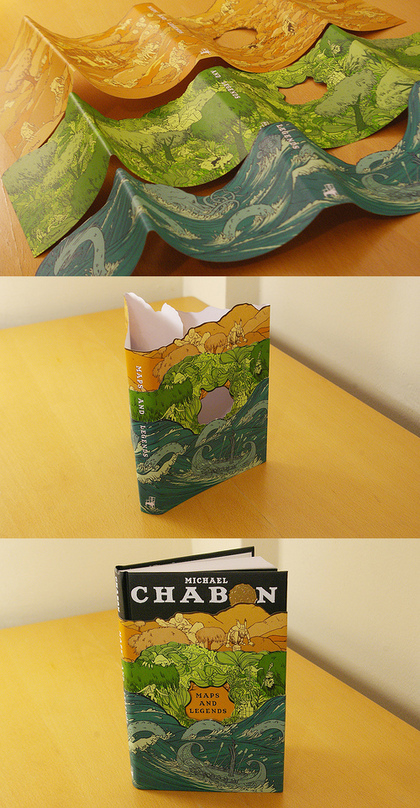
Michael Chabon's Maps and Legends

I have a strange (though not necessarily bad) habit of finding wildly famous writers of fiction, ignoring their novels, and reading their essay collections instead. I did the same thing with Jonathan Franzen last fall, and I just did it again with Michael Chabon's collection of essays Maps and Legends
Maps and Legends with its gorgeous set of mythical layered dust jackets.
It's an absolutely stunning book to hold (way to go, McSweeney's!) and an engaging text to spend time with. For some reason, I kept comparing Chabon's book to Franzen's How to Be Alone--in part because they're both works by critically acclaimed and much lauded contemporary writers of fiction, and in part because they take on such similar topics (for example, The State of Modern Fiction and Reading) in such wildly different ways. Where Franzen is serious and brilliant and critical, Chabon is enthusiastic and blithe and mercurial. Franzen's writing is more precise and persuasive, but Chabon's is more engaging; I wish I could take a literature class with Franzen as my teacher, but I wish I could take Chabon out for a beer to talk about our promiscuous reading habits.

Chabon's collection contains essays on the state of the modern short story, the dangers of labeling novels by genre (he considers the library's system of categorization--science fiction, mystery, young adult, etc.--to be a sort of ghettoization), Philip Pullman's His Dark Materials Trilogy, the history of Arthur Conan Doyle and Sherlock Holmes, the myth of the golem, the importance of comics for children and adult readers, and his childhood love of Norse mythology. (If you know my reading habits at all, you can see why the table of contents practically forced me to get my hands on this collection!)
Chabon with superheroes.

While much of the essays are what could be called light or popular literary criticism (usually a serious, if accessible, genre), at its heart, the book is a gleeful celebration of reading for pleasure and entertainment. I think that the world of literature might be a better place if all authors--Pulitzer Prize winners or not--were able to occasionally admit to Chabon's thesis: "I read for entertainment, and I write to entertain. Period."
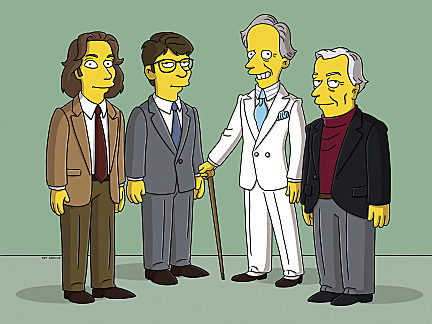
Chabon, Franzen, Tom Wolfe, and Gore Vidal as seen on The Simpsons.

4.19.2011

How Way Leads on to Way

I've been away. You may have noticed.  :P

My new job has taken a lot of adjusting to these past few weeks. I like the work, but traveling back and forth has eaten up much of my free time, and I'm still getting use to it. On top of that, my poor, lovely, stubborn mother has been in the hospital with an unusually nasty strain of pneumonia. She's back home and feeling better now, but I was worried for her. So, dear blog, I'm sorry, but you just haven't been a priority.

But since I've last visited, I've been reading a lot and enjoying my Netflix subscription and trying (trying!) my best to take it easy in my time off. I've been in a particularly fun sort of reading/television watching path--it's one of my favorite things about being out of school and being able to direct my own reading. I choose books with perfect freedom and whimsy, and I never run out of new strands of interest to follow. Each new book I read has the potential to sling me off into some new interest that I never expected to love. In reading as in life, as Frost puts it, "way leads on to way."

Most recently, I've been loving all things Sherlock Holmes, which I never in my life thought I would be interested in. I used to think that I didn't like mystery novels or crime stories, and police detectives in tweeds smoking pipes seemed like the dullest thing possible. But here's what happened:

  • I watched that fantastically witty Doctor Who episode where Agatha Christie solves a real-life murder mystery involving a giant space wasp. (Yes, that episode is as awesome as it sounds.) -->
  • Curious about Christie, I read The Murder of Roger Ackroyd, Murder on the Orient Express, and Death Comes as the End. They were great--very clever and well written and British and astute. -->
  • Thinking that I now liked old-fashioned British mysteries, I rented the new Sherlock Holmes action movie with Robert Downey, Jr. and Jude Law. I surprised myself by really, really enjoying it. -->
  • Intrigued by the eccentricity of Holmes in the movie (drug use, bizarre fits of melancholia, a deep and curious jealousy of his friend Dr. Watson, etc.), I spent some time researching Holmes and Arthur Conan Doyle on Wikipedia.  -->
  • Curious about Doyle's writing and the oddity of Holmes as a character, I read two of the Holmes novels (A Study in Scarlet and The Hound of the Baskervilles). They were fun, easy reading, as clear and fast-paced as if they'd been written in the late 20th century, not the late 19th. -->
  • Because I enjoyed these novels, I decided to read Laurie R. King's The Beekeeper's Apprentice (which features Holmes in later life, living in semi-retirement in the 1920s and 1930s). -->
  • King's version of Holmes was fantastically appealing, even better than the original! On top of the typical Holmes-style plot lines, there was a brilliant feminist female sleuth to keep Holmes in check (Mary Russell!) and a romantic sub-plot and really cool flapper clothing. So I read the next two novels in the series (The Monstrous Regiment of Women and A Letter of Mary) and loved them. -->
  • Finally, I took Netflix's suggestion and started watching the Granada Sherlock Holmes series from the 1980s and 1990s with Jeremy Brett. I loved it and spent a good chunk of this weekend watching Holmes chase down Professor Moriarty and a dozen other amateur thieves and murderers. I never, ever thought I'd have an opinion about Dr. Watson as a narrator or the nattiness of Victorian-era men's clothing, but now I do. So yay!

So what's next? Inspired by King's Mary Russell novels, Downton Abbey's portrayal of pre-World War I Britain, and Ishiguro's conflicted post-World War II butler in  The Remains of the Day, I'll probably track down some more great modernist British literature. But who knows where I'll end up next?

Goodness, isn't reading fun?  :D

3.21.2011

Howl, Howl, and Howl

What sound does a working woman in her mid-twenties make the morning after her first softball practice in two and a half years?


Why, how did you guess?

Softball practice was fantastically fun yesterday, but I'm paying for it today. I'm having trouble opening doors, people--I mean, lifting my arm, turning a knob, and stepping forward hurts. Who knew that throwing a ball and crouching for grounders and darting across a muddy field for an hour and forty-five minutes could do that to a body?

In less painful news, I finally saw Howl this weekend. Howl is a "biopic" about the obscenity trial that followed City Light's release of Allen Ginsberg's Howl and Other Poems  in 1956, but the movie was nothing like what I expected.


I thought the movie would be a typical biopic in the style of Walk the Line or Lean on Me or Braveheart: conventional and predictable and utterly sentimental. Instead, the obscenity trial that the film is supposedly about serves as little more than a backbone for the 84 minutes of poetic action, a mere cage of plot line over which the filmmakers draped the central components of the film: the interview scenes with Ginsberg (played by James Franco) and the poem itself (which is read by Franco and beautifully animated). Really, the poem is what gives the movie all its heart and soul and interest; I wouldn't have minded a 45-minute movie with nothing but black-and-white scenes of Franco reading Howl in a Village bar spliced with bits of that lovely, vivid, frightening animation.


I was especially fond of the animators' portrayal of Moloch, the poem's "villain" (see above).

Once I got past expecting an actual plot to appear, I really enjoyed the movie, and I loved it best for reminding me of how much I used to love Ginsberg. He's one of my favorite 20th-Century poets, and I've read a ton of his poems and interviews. (In fact, the first poem I ever published was very Ginsberg-inspired, with long lines and stacks of lists and happy over-the-top joyful cosmic hysteria). He was severely out of vogue at my grad school, so I hadn't read him in years, but in 2004, I pretty much wanted to be Allen Ginsberg.


"You were never no locomotive, Sunflower, you were a
sunflower!"
Watching Howl made me pull out my copy of Ginsberg's Selected Poems: 1947-1995, which (according the the receipt I found in the book) I bought from The Raven Bookstore in 2005. I reread my favorite sections of Howl (the "I am with you Rockland" section and "Footnote to Howl" with all its holy holy holy holys) and flipped through to see what poems I had marked back in 2005. It made for a lovely evening, actually.

I would definitely recommend Howl (the movie) to anyone who's read the poem and, while I'm at it, to anyone who hasn't read the poem. I believe that Franco reads the entirety of the poem over the course of the movie, and the filmmakers do an excellent job of getting to the heart of what Howl (the poem) is all about. They also did quite a good job of portraying Ginsberg as the complicated figure that I always imagine him to be: a poet, a revolutionary, an unloved lover, a square, a Beat, and an all-around brave and joyful human being.

3.13.2011

Eat, Pray, Love

Honestly, I was hesitant to read Elizabeth Gilbert's Eat, Pray, Love. It was just so damn popular--so popular that it spawned a Julia Roberts movie (an outcome that, I think, many a writer would dread). C'mon, I thought, how could Eat, Pray, Love turn out to be anything other than cheap tourism and stories about tiramisu and hunky Italians and faux-spiritual enlightenment and steamy tropical romances?


 Fortunately, I was wrong. My mom convinced me to give Gilbert a chance, and I'm so pleased that I pulled one of my local library's fifteen copies of this memoir off the bookshelves. It's a lovely piece of writing and self-exploration, a breathtakingly honest and cleverly written chronicle of Gilbert's sojourns in Italy, India, and Indonesia.

Gilbert's memoir is not literary-ly ambitious but personally so: She's writing the type of confessional non-fiction that holds very little back, and so a reader's enjoyment of the book hinges not on whether or not you like the story, but whether or not you like Liz Gilbert, Narrator. And though I did occasionally find her neuroses irritating, I really, really liked Liz Gilbert: I admired her emotional and spiritual bravery (both as a traveler and as a writer), even when I didn't necessarily "get" her.

Of course, this is how most personal essays and memoirs are meant to be. For example, E.B. White's One Man's Meat isn't brilliant because of its stories (in fact, I don't remember any sort of "plot" anywhere in the entire book) but because of the richness of White himself. It's the same with Gilbert's book: despite the way the memoir was marketed (as a sort of chick lit/humor/travel memoir hybrid), Gilbert's writing is so rife with personality and literary references and carefully crafted scenes that she places herself squarely within the tradition of classic personal essayists. Even when there wasn't much action going on (especially in the Italian chapters), Gilbert's voice, her obvious intelligence, and her wide-ranging literary and spiritual references make this book rich and worthwhile.

I ended up reading this very quickly and with great pleasure and found myself marking favorite quotes again and again. Here are a few that stuck with me, even after I was done:
"But I felt a glimmer of happiness when I started studying Italian, and when you sense a faint potentiality for happiness after such dark times you must grab onto the ankles of that happiness and not let go until it drags you face-first out of the dirt--this is not selfishness, but obligation. You were given life; it is your duty (and also your entitlement as a human being) to find something beautiful within life, no matter how slight."
"Happiness is the consequence of personal effort. You fight for it, strive for it, insist upon it, and sometimes even travel around the world looking for it. You have to participate relentlessly in the manifestations of your own blessings. And once you have achieved a state of happiness, you must never become lax about maintaining it, you must make a mighty effort to keep swimming upward into that happiness forever, to stay afloat on top of it. If you don't you will leak away your innate contentment."
 "But what I have come to realize is that, when the patriarchic system was (rightfully) dismantled, it was not necessarily replaced by another form of protection. What I mean is--I never thought to ask a suitor the same challenging questions my father might have asked him, in a different age. I have given myself away in love many times, merely for the sake of love. And I've given away the farm sometimes in that process. If I am to truly become an autonomous woman, then I must take over that role of being my own guardian."
"My thoughts turn to something I read once, something the Zen Buddhists believe. They say that an oak tree is brought into creation by two forces at the same time. Obviously, there is the acorn from which it all begins, the seed which holds all the promise and potential, which grows into the tree. Everybody can see that. But only a few can recognize that there is another force operating here as well--the future tree itself, which wants so badly to exist that it pulls the acorn into being, drawing the seedling forth with longing out of the void, guiding the evolution from nothingness to maturity. In this respect, say the Zens, it is the oak tree that creates the very acorn from which it was born."
 And, finally, one very, very lovely bit of language:
"I walked home that night feeling like the air could move through me, like I was clean linen fluttering on a clothesline, like New York itself had become a city made of rice paper--and I was light enough to run across every rooftop."
All quotes taken from Elizabeth Gilbert's Eat, Pray, Love (Viking 2006).

2.10.2011

Dear Blog,

I miss you. I really do. I want to write posts for you about snow days and this really good new sugar cookie recipe I found and Eat, Pray, Love and walking in the cold and writing essays and . . .


*sigh*

You get the idea.

But things have been busy here in Lesley Land. I took on an editing job last week that had a very tight deadline. It was a fun project, but it kept me busy all last week. Regular work has been unbelievably busy because of the snow days, and I've been furiously playing catch up for a solid week now. And then last week my writing group members decided that it was time for me to wrap up the essay I've been working on and submit it, so I've been furiously churning out 1,500 words per night all week long--and I'm still not done! Now I'm hoping to whittle it down and send it off early Saturday afternoon.

So, blog, know that I miss you. Know that I keep having ideas for you and writing them down, right before I go off and edit and/or write and/or work really hard and/or go to the gym to stay sane.

Anyway, I'll visit again soon.

Much love,
Lesley

1.21.2011

Winter Is Magical!

And then you have to go outside. Gah! The cold--it burns!

In case you don't live in Kansas (or are an inveterate agoraphobe who never leave his/her house), it's been snowy and then cold and then snowy and then really, really cold again. I haven't been going outside much. In fact, pretty much all I've been doing is sitting on my couch attired in sweatpants, a hoodie, thick socks, and a lap-loving cat. My constant companions have been soup and herbal tea and young adult fantasy novels (Suzanne Collins and Phillip Pullman!) and a very cozy knitted blanket. Occasionally a Boulevard Amber Ale (my new favorite winter beer) makes it into the mix. Aaaaand that's about all the variation you're going to get.

Besides hibernating, I've also been extremely busy at work with the beginning of the semester and enrollment season. I like being busy and all, but dang! I don't even want to think about how many enrollment emails I've been sending. Obviously, I've been completely unmotivated to turn on my computer at home for blogging. The thought of it makes my fingers ache.

All in all, things have been good here. Maybe I'll get back into the swing of blogging soon. Or maybe it's time to start Catching Fire. Hmmm . . . decisions, decisions, decisions!

12.27.2010

What I Learned from Bertrand Russell and Doctor Who

I ran across this quote from Bertrand Russell's The Conquest of Happiness the other day:
Fundamental happiness depends more than anything else upon what may be called a friendly interest in people and things.
I think that this is fundamentally true. However, I must be honest: my evidence for this comes from a) my personal experience and b) Doctor Who. Yes, I know what you're thinking: Now she's taking life lessons from that silly show?! Well, yes. (And famous 20th-century philosophers! Don't forget about them!)

But, really, one of my favorite things about the Doctor is how excited he gets about things, even when he really doesn't have much reason to be enthusiastic. By most standards, he should be unhappy: he's a 900-year-old time traveler with no family, no home planet, no one to understand his crazy alien ways, a distinctly junky spaceship, a bunch of cranky alien enemies who would really enjoy killing him, and a really rocky love-life with his human lady friends. Oh, and he only owns one outfit, and it happens to be a pinstriped suit, which seems really inconvenient for adventuring. Not to mention the fact that he sometimes has to depend on 3-D specs to save the day. For realz.

But he's really, really, really fascinated by the universe and things and life and people, and so he manages to keep happy on a daily basis. Example: About to be killed by a clockwork android? Beautiful! He thinks it's a lovely bit of machinery and he'd like to meet whoever made it! Has to depend on a half-genius, half-birdbrained human scientist to bring him back through a worm hole and save the world? Great! Randy the Scientist is his new best friend when he's in south London! Meets Satan right on top of an inescapable black hole? Fantastic! It just means that he didn't know as much about the universe as he thought he did!

Pretty much every life-or-death situation turns into a kind of romp of appreciation for the Doctor, and it's contagious. Yes, he's a fictional character, but that sort of indefatigable enthusiasm for life, that giddy interest in our diverse and myriad world, seems like a great recipe for never really getting bored or growing old.

So for the last few months, one of my goals has been to get really excited over something, anything, everyday. It doesn't take much: some article about a crazy new scientific discovery, a mind-blowing Wikipedia article, a good trip to the gym, hearing to a fantastic song I've never heard before, listening to someone tell a crazy story about his/her life, whatever. The topic doesn't much matter. The point is to love something, anything, for the sake of loving, to appreciate something purely for the sake of appreciating anything.

Making a daily practice of loving some bit of the world: this seems like one of the easiest, more rewarding paths to happiness I can imagine. And I I'm glad to hear that Mr. Russell thinks so, too.

12.22.2010

Lonesome Literature

When the title of a book has the word "lonely" in it, remind me to pay attention in the future.

I finished Carson McCuller's The Heart Is a Lonely Hunter a few weeks ago. I bought it at The Dusty Bookshelf because I liked the cover and because I was in the mood to read a serious novel and because I wanted to read something set in the South. It's winter, goshdarnit, and I want to dream of hazy humidity and mossy trees and thick brambles of green.


I don't regret reading the book--in fact, I thought it was one of the best novels I've ever read--but this really wasn't the best time of year to read it. It's a book whose topic is loneliness. The novel follows John Singer, a deaf mute living in a small Southern town in the late 1930s. His best friend, another deaf mute, has been sent to a mental institution many miles away and, for the first time in his ten years of adulthood, no one can "hear" him speak.

As he copes with this loss, Singer moves into a new boarding house and begins to be visited by strangers who feel compelled to talk to him: Dr. Copeland, a black doctor who reads Marx and Spinoza and is desperately, painfully committed to helping his people escape oppression; Jake Blount, a half-mad alcoholic anarchist and labor activist; Biff Brannon, a cafe owner and recent widower who wants to understand Singer and the people who follow him; and Mick Kelly, the 14-year-old girl who dreams of moving to the snowy north and becoming a musician and who has Mozart's symphonies playing constantly in her head.

All of these characters, particularly Dr. Copeland, Jake, and Mick, and burning with a passion that no one else in the town is able to access or understand. And all of them, the quiet Biff and Singer included, are hounded by loneliness, the desire to be heard and to be understood. Singer follows his mad friend, aching to use his hands to speak directly to someone who understands him. Dr. Copeland and Jake and Mick chase Singer, feeling paradoxically that the lip reader is the only man on earth who understands them. Biff watches them all out of the new emptiness his wife's death has created, wondering what all this loneliness means in the world.

Despite the characters' passions and yearnings and hungers, it's a novel where very little happens. Usually, I dislike plotless novels, but McCuller's characters are so brilliantly drawn, so lifelike and complex and beautiful and sad, that I was rapidly pulled through the 300+ pages of the novel by pure curiosity. I desperately wanted to see these characters' lives become better because I understood their motives in the same way that I understand my own. McCuller's creates true empathy in this novel, and she does so brilliantly.

Mick Kelly especially comes to life. She made me remember being 14, feeling constantly confused and over-excited and angry and hungry and passionate for art--books in my case, music in Mick's. I get the impression that McCullers (who was only 23 when she wrote the novel) modeled the character after her own childhood and, I presume, her own desire to be a writer.

The Heart Is a Lonely Hunter is a novel I would recommend to anyone, but not in November or December. It's the kind of heavy reading that's best reserved for the summer months, when there's sunshine and plenty to do and the world feels all fat and lazy and happy and slow. One needs the summer to counteract messages like "deep and soul-wrenching loneliness is intrinsic to human life and is its greatest and most painful motivator." Ack! The winter is just too cold for novels like this.

I thought I learned that lesson a few years ago when I read Ethan Frome and Jude the Obscure, two of the saddest novels ever written in America, in the same week in December. No, thank you! This time, the lesson's going to stick! It's only The Golden Compass and Do Androids Dream of Electric Sheep? and Tamora Pierce from here until March, people! Loneliness is an excellent topic for excellent novels, but a terrible topic for mid-winter ruminations.

11.21.2010

The Mystery Engine

This week, I've been reading my first Agatha Christie novel: The Murder of Roger Ackroyd. I've read a few mystery novels before, and I've never really liked them. I either guess the murderer way too early, which leaves me bored and impatient, or I'm completely lost and confused and I just want the author to tell me who did it already.

But Christie is different. Despite the shortness of her novels, her characters are astonishingly complex and surprising and funny, and she colors them richly with just a few deft strokes of very British humor. She also doesn't write straight up "whodunnits," as far as I can tell. What propels the reader through the book isn't solving the mystery, it's figuring out what each character is hiding--it's discovering what each person wants, who each person really is, and what he or she believes that they must hide from the world. It makes for fascinating reading.

I suspect that writers of bad mystery novels tend to think the wrong way about the mystery genre: people don't really care about crime or culpability. Instead, I think that we all care unfailingly about people, the complexities of the human mind and human motivations. As in all literature, people and their personalities, our neighbors and their passions and secrets, are the engines of mystery novels, not the mystery itself.

11.08.2010

Enamored

I'm having one of those days where all I want to do is lay on my couch and read about a zillion books and do a little writing. Maybe I'm just growing weary of daleks daleks daleks all day long, but it's come upon me suddenly, the hunger for words. It happens. I've added five or six books to my Goodreads To Read shelf in the past few days. I want to read lots and lots of sci-fi and steampunk and cyberpunk and go back to my gloriously nerdy roots. I'm hungry not for high literature or for sentimental feeling or for postmodern ambiguity but for thinking. I want ideas, big, chewy, crunchy ideas with lots of vitamins and fiber and nutrition and maybe some sprinkles on top.

Anyway. You get the idea. It's lunch time, obviously. Here are some other things I'm enamored with:
  • My new iPod Nano, which my lovely parents bought me for my birthday because they are awesome and because they love me
  • Putting together lots of new playlists for my new iPod Nano after the gym tonight
  • Laurell K. Hamilton's Meredith Gentry series. I mean, the woman can make faeries (faeries?! are you kidding me?) into fantastically creative and compelling mystery novels for adults. She is obviously some kind of genius.
  • 70 degree days in November, warm breezes, cool skies, the chilled and rainy days to come.
  • My birthday tomorrow. I plan on getting a massage, buying a bottle of red wine, ordering Indian take-out, and settling in for the night with a good book, which sounds like pretty much the best idea I've ever had.
  • This brief essay by Lera Auerbach on The Best American Poetry blog
  • This fantastically textured, moody, profoundly beautiful poem by Claudia Burbank on the same blog.
Enjoy, folks, and have a happy Monday.
---------------

Geranium

Thank you for the dead geranium, red
memory of a short-stemmed city.
For nickel shows, tea rooms, the rotten-egg
mill-smell that crept between the fretted sheets.
For elms that divided our limbs with dusk,
and twisted things in ash trays, girls lit with gin,
long trains moaning, the night in a plum.
Thanks, too, for captured Kaiser helmets stowed in attics,
the Alligator Man and Monkey Woman at the circus,
and rented clarinets, and dented trombones,
ladies in a savage dance, hair bound high.
Thanks, perhaps, for noon, the dark bird’s love call,
being born on ice, out of wolf, wolf.
For the stately progress of capped men
towards a gray chowder, something shaken by the gills.
And all that we devoured, and all that didn’t drown.
--Claudia Burbank

10.14.2010

Curiosity

As you know, I'm working on putting together a chapbook out of some old poems from my thesis. Most recently, I've been grappling with a poem about Greek water clocks. It's a topic that I find complex and strange and absolutely fascinating, but I know that most people have no idea what a clepsydra is and, to be honest, they don't give a damn.

And that's perfectly fine. The problem is that this poem is dependent upon a knowledgeable audience or, even better, an audience willing to hit up Wikipedia when confusion strikes. It's also a poem that draws my attention to my own knowledge, to my own academic backgrounds. It makes me hyper-aware that I've spent more of my life learning about Greek history and literature than most people care to, and yet I still know so little about it. It's a topic that sounds very learned and obscure, but really I'm only scraping the surface of a whole fascinating field of study that some scholars of Greek archaeology have dedicated their lives to. I'm an amateur at best.

This makes me think about my other areas of "expertise": poetry, American literature, personal essays, baking, etc. But what I know about, say, poetry is just a smattering in a huge field that's bursting with poets and poems I've never heard of. I can name at least twenty people I know personally who know a heck of a lot more about poetry than I do. I know that, even in this, my primary field of expertise, it's absolutely impossible to know everything, and it's nearly impossible to gain mastery over even a fragment of such a wide field. For example, it would take a lifetime of study and reading and thinking to master a tiny category like Post-Modernist Midwestern American Poetry By Women written after 1960.

Sometimes, I find my persistent and unavoidable ignorance to be depressing, but more often I find it thrilling and even comforting. A friend once told me that libraries make her sad because she walks into the stacks and knows that she will never be able to read all the books that she sees. But this is the exact reason that libraries make me so happy: no matter how hard I work to learn, there will always be too much to know in my lifetime, and there will always be some work left for someone else to do.

There is a limit to what one man or woman can know. In a library full of hundreds of packed shelves and millions of volumes, each of us can only read a few shelves worth in a lifetime. No matter how boundless our curiosity is, the world is always much vaster and much greater than our aspirations, and this, I know, is a gift.


10.01.2010

Random Five for Friday

  1. Dead Tired. I've been planning to write a blog post all this week, but I didn't expect for my travel hangover to last quite so long. I have been beat. My trip to State College was fantastic, as was my family reunion in Marion, but they made for a whole lot of traveling and not a whole lot of sleeping. So my post in praise of Susan Orlean will just have to wait until next week!
  2. Spicy Food. This week, I attempted vegetarian chili, which is basically a bunch of beans with some spices and tomatoes thrown in. The problem with vegetarian chili is that meat adds a good deal of fat and flavor that is indispensable to the whole chili experience. I was forced to turn to lots and lots of red chili flakes to make my chili appetizing. My taste buds have been feverishly thrilled all week, but every day my stomach growls at me and says, WTF, Lesley! Are you kidding me? MORE of this stuff? Ahhh! Stop it!!! Where's the Tums?!
  3. Good Reads. I finished two really excellent books this week: The Art of Losing (a collection of poems on mourning that I wrote about here), and Jonathan Franzen's How to Be Alone. I picked up Franzen's essay collection because I was curious about his writing, but I didn't want to commit to taking part in the Freedom "best novel of the century" hoopla.Though many of the book's essays are about reading and the state of the novel, How to Be Alone consists largely of an old-fashioned curmudgeon's complaints about modern society (its disinterest in serious fiction, its mindless passion for new technologies, its meaningless passion for privacy, etc.). It can easily be read as a work of late adopter naysayer-ism that frequently contradicts itself, but Franzen is so brilliant in his thinking and so adept in his prose styling that you're willing to growl and harrumph along with him, just for the pleasure of spending time with his voice. The collection made for surprisingly good airport reading material, and it's convinced me to put The Corrections on my to-read list.
  4. Writing & Wranglin'. The last week's busyness has put a serious crunch on my writing time, so the writing has been going slowly. I'm in the process of radically revising my chapbook, and I'm trying to work my way through a new process of drafting and revising. In grad school, I had to write fast to keep up with the pace of workshop (I wrote one poem a week for years!). Now, I'm trying to write more slowly and to think more deeply. Instead of playing with images and making up the substance as I go along, I'm trying to clarify the ideas and feelings I want to express before I start worrying about image and diction and line length. I think that this will be an excellent method in the long run, but it's trying right now. Writing more truthful, more emotional, more intellectually interesting poetry is hard. I'm trying for a sort of clarity that is extremely difficult to achieve. So, like one of my Penn State MFA Reading Series t-shirts says, I "Just Keep Pounding Those Keys!"
  5. Wedding Weekend. Last night, one of my third cousins got married. She's having her wedding reception in Abilene this weekend, and I'm going with my mom. Though I'm not thrilled to be traveling for the second weekend in a row, I'm really looking forward to it. Charlie's stepfather once told me that the quality of a wedding always depends on the feeling between the couple. If the couple is joyful and deeply in love, the wedding celebration will feel joyful and easy and sincere. Consequently, I expect this weekend's celebration to be an excellent one. :)